_1778603447189-DGEkYDPq.png)
The 24-hour rule: why slow Cyber Hiring is now a board risk

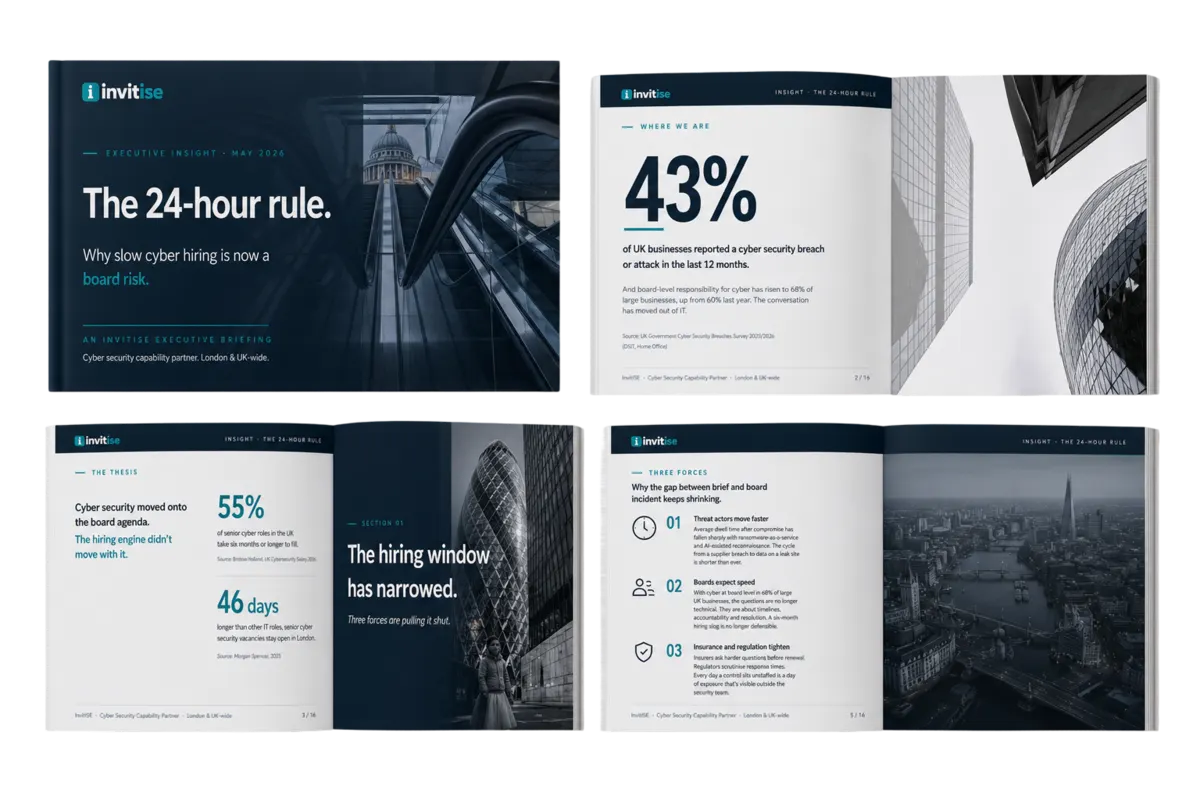
Cyber Security has moved onto the board agenda. The hiring engine hasn't moved with it. Here's why the gap between brief and on-site is now the metric that matters.
In the year to December 2025, 43% of UK businesses reported a Cyber Security breach or attack. Across larger firms, 68% now hold Cyber Security at board level. The pattern is clear: the conversation about cyber has moved out of IT and into the risk register.
What hasn't moved with it is the hiring engine. Around 55% of senior cyber roles in the UK still take six months or longer to fill. For specialist contract roles, the wait is often weeks. For a board that's just been told an attacker has a foothold in a supplier's network, weeks may as well be never.
The 24-hour rule isn't a marketing line. It's the operational reality of how fast cyber capability now has to mobilise.
The hiring window has narrowed
There is a window between the moment a CISO realises they have a gap and the moment the gap becomes a board incident. That window used to be a quarter. Now, depending on the threat picture, it can be a week.
Three things are pulling the window shut:
- Threat actors move faster. Average dwell time after compromise has fallen sharply with the rise of ransomware-as-a-service and AI-assisted reconnaissance. The cycle from a supplier breach to data appearing on a leak site is shorter than ever.
- Boards expect speed. With cyber at board level in 68% of large UK businesses, the questions are no longer technical. They are about timelines, accountability and resolution. A six-month hiring slog is no longer a defensible answer.
- Insurance and regulation are tightening. Insurers ask harder questions before renewal. Regulators scrutinise response times. Every day a control sits unstaffed is a day of exposure visible to people outside the security team.
The bottleneck isn't supply
The convenient explanation is "there aren't enough cyber people". It's not quite true. 160,035 cyber roles were posted in the UK in the last twelve months, with around 37% classified as hard to fill. The challenge isn't a missing population. It's that the people you need are already engaged, somewhere, on something else.
Reaching them requires a network you have already invested in. Not a database. A network: relationships maintained over years, conversations had last quarter, knowledge of who's coming free at the end of a contract.
That's the work that doesn't happen at the moment a brief lands. It happens long before. The firms that can move at 24-hour speed have already done it.
What "on-site within 24 hours" actually requires
A genuine 24-hour turnaround on a specialist contract role is not a marketing claim. It's a delivery model. It requires four things working in concert:
- A pre-qualified pool of vetted specialists who have explicitly said they want to know when work comes up.
- Live awareness of who is available, this week, at what rate, for what kind of environment.
- A senior point of contact who can take a brief, run it through a known shortlist, and put forward the right one or two people rather than a long list.
- Compliance and contracting wrapped in advance so there is no paperwork delay on day zero.
Most cyber requirements that fail to land within 24 hours fail at one of those four points. Not because the talent isn't there. Because the operational layer between brief and on-site isn't.
The board conversation has changed
Cyber moving to board level isn't just about who reports to whom. It has changed the criteria. Boards are no longer asking "did you find the right person". They're asking "how long was the gap, and what was the exposure during it".
That changes what counts as a successful hire. Speed, sequencing and the ability to keep a programme moving have become as important as the calibre of the individual. A perfect candidate who arrives in week 14 is, in board terms, a failure.
A different operating model
invitise runs to a different cadence. We work with a small group of organisations at any one time. Our network is small enough to know personally and large enough to cover the disciplines that matter. We can be on-site within 24 hours because we are already on the call with the right people the day before you need them.
Call before 11am. The right person is with you the next morning. That's the standard. It isn't unusual. It is the operating rhythm of Cyber Security delivery in 2026.
If your team is mid-transformation, mid-incident, or mid-programme and the gap is widening, we can help. The first conversation is 15 minutes. A direct answer about whether we can move at the speed you need.
Talk to us about the 24-hour standard →
Sources & further reading
Want to talk about this? Get in touch →
All insights →More from Market Insight
 Market Insight
From day rates to outcomes: the shift to fixed-price cyber in 2026
Joint & Several Liability rules landed in April. End clients no longer want to assess IR35 status on every contractor. Fixed-price Statements of Work are becoming the default. Here's what genuine outcome delivery looks like.
Market InsightThe UK cyber skills gap is widening. What it means for hiring in 2026.
11,200 unfilled Cyber Security positions, 49% of organisations short on capability. We unpack what the latest Gov.uk skills report means for in-house teams and how leaders are responding.